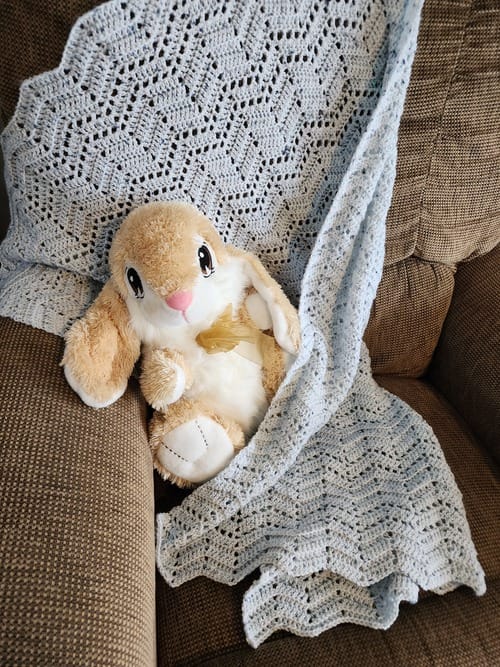
Ripple Stripe Crochet Afghan

How it Started
I had done a little bit of crocheting as a child, but it didn’t stick right away. Then the winter of 1996/1997 hit – so many snowstorms that we were snowed in for many days that winter.
I was incredibly fortunate. My grandmother lived just two houses down from me and didn’t miss a day without crocheting something. Whenever really bad weather was predicted I’d take a day of vacation from work (can’t exactly drive 50 miles round-trip in a blizzard anyway) and walk over to Grandma’s for a crochet lesson.
First Pattern Language
That first winter, I learned crochet from watching Grandma and learning to read diagram patterns. Those pictures and symbols became stitches for me with just a glance. I think largely in numbers, grids, patterns and diagrams, so for almost 25 years I could only crochet from that type of pattern or from seeing an example or swatch so I could visually understand the stitches.
The New Language
Eventually, I wanted to do projects for which I could not find diagrams. All that was available for some of them was in this weird language…
Row 6: ch 3, turn, (dc, ch 1, sk 1) 3 times, dc, sk 2, (dc, ch 1, sk 1) 3 times, dc, [ch 2, (dc, ch 1, sk 1) 3 times, dc, sk 2, (dc, ch 1, sk 1) 3 times, dc] 10 times, put a second dc in the final st.
“Wow, that looks complicated.” That’s what I used to think — until I simply gave it a try.
Telling myself to look at the meanings for the abbreviations, maybe write it out in long form. You can make this make sense! And it did. It opened up a whole new world of possibilities!
Now most of the patterns I use are written in this new language and I’ve learned to speak it as well.
Why I Love This Pattern
The Ripple Stripe pattern is incredibly versatile. I sometimes repeat the rows with chain spaces every other row or every third row to create a lighter, lacy effect.
For those who enjoy adjusting patterns, it’s very easy to personalize. The pattern is worked in multiples of 16 chains, plus 3 to begin. Want it wider? Add 16 chains for each additional “v” section.
I find this pattern very meditative. What I especially love is that the side edges stay nice and straight all the way up, so I never need to add edging. When I tie off that last row, I’m done.
I’ve written out the Ripple Stripe pattern clearly in standard U.S. terms, with both full-size and baby-size instructions, so if written patterns are your language too — or if you’re learning it — you can enjoy the rhythm of it as much as I do. If you are interested in purchasing, you can find it in my shop under Ripple Stripe Crochet Afghan.
🌼 You Might Also Enjoy…